
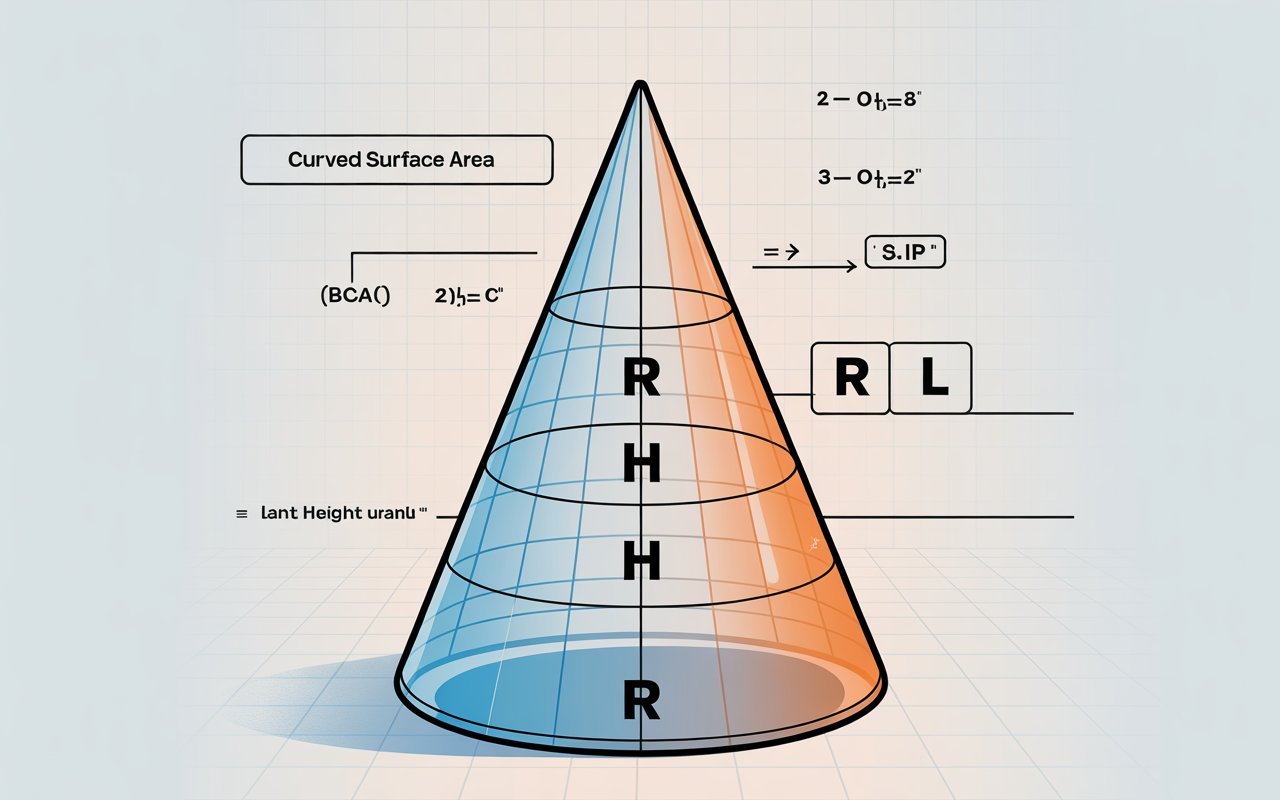
The curved surface area, often abbreviated as CSA of cone, is a fundamental concept in geometry that plays a key role in both academic learning and real-world applications. Whether you are a student trying to grasp geometric formulas or someone exploring practical measurements, understanding this concept can be very useful. A cone is a three-dimensional shape with a circular base that tapers smoothly to a single point called the apex. The curved surface area represents the outer surface excluding the base, making it an essential measurement in various calculations and designs.
What is CSA of Cone
The CSA of cone refers to the area that covers only the curved portion of a cone, excluding its circular base. This measurement helps in determining how much material is required to cover the outer side of a cone-shaped object. It is commonly used in problems involving surface coverage, such as painting or wrapping. Understanding this concept begins with recognizing that the curved surface forms a smooth, continuous shape from the base to the apex. The CSA depends on two important elements, which are the radius of the base and the slant height of the cone.
Formula for CSA of Cone
The formula used to calculate the CSA of cone is simple yet powerful. It is given as pi multiplied by the radius and the slant height. This formula connects the geometry of the cone to measurable values, making calculations straightforward. The slant height is the distance from the base edge to the apex along the surface, not vertically. When both the radius and slant height are known, the curved surface area can be calculated quickly. This formula is widely used in mathematics, engineering, and design to determine surface requirements efficiently and accurately.
Understanding Radius and Slant Height
To fully understand the CSA of cone, it is important to know the meaning of radius and slant height. The radius is the distance from the center of the circular base to its edge. The slant height, on the other hand, is the diagonal distance from the base edge to the tip of the cone. These two measurements work together to define the curved surface. The slant height is usually longer than the vertical height, and it plays a direct role in the surface area calculation. Knowing how to measure or calculate these values is essential for accurate results.
Difference Between CSA and Total Surface Area
Many learners confuse the CSA of cone with the total surface area, but they are not the same. The curved surface area includes only the outer curved part, while the total surface area includes both the curved surface and the base. The base of a cone is a circle, and its area is calculated separately. When added to the curved surface area, it gives the total surface area. Understanding this difference is important when solving geometry problems or applying these concepts in real-life situations such as construction or product design.
Real Life Applications of CSA of Cone
The CSA of cone has many practical applications in daily life and various industries. It is used in designing objects like ice cream cones, funnels, party hats, and lampshades. Engineers and designers use this concept to calculate material requirements and ensure efficient use of resources. For example, when creating a conical tent or covering a structure, knowing the curved surface area helps determine how much fabric is needed. This concept also plays a role in manufacturing and packaging, where precision and cost efficiency are important factors.
Step by Step Calculation Method
Calculating the CSA of cone involves a clear and simple process. First, measure or identify the radius of the base. Next, determine the slant height, which may be given or calculated using the Pythagorean theorem if the vertical height is known. Once both values are available, apply the formula by multiplying pi with the radius and the slant height. It is important to keep units consistent during calculation to avoid errors. This step-by-step method ensures accuracy and helps students build confidence in solving geometry problems effectively.
Common Mistakes to Avoid
While working with the CSA of cone, students often make avoidable mistakes that lead to incorrect answers. One common error is confusing slant height with vertical height, which changes the result significantly. Another mistake is forgetting to exclude the base when calculating curved surface area. Some learners also make calculation errors by not using the correct value of pi or mixing units. Being careful with measurements and understanding the formula clearly can help avoid these issues. Practice and attention to detail are key to mastering this concept.
Importance in Academic Learning
The CSA of cone is an important topic in mathematics education, especially in geometry. It helps students understand three-dimensional shapes and their properties. Learning this concept builds a strong foundation for more advanced topics in mathematics and science. It also improves problem-solving skills and logical thinking. Teachers often include questions related to cones in exams to test conceptual understanding. By mastering this topic, students can perform better academically and gain confidence in handling complex calculations involving shapes and measurements.
Tips to Remember the Concept Easily
Remembering the CSA of cone becomes easier with a few simple strategies. Visualizing the cone and its curved surface helps in understanding the concept better. Associating the formula with its components, radius and slant height, makes it easier to recall. Practicing different types of problems regularly strengthens memory and improves speed. Using diagrams and real-life examples can also make learning more engaging. Consistent revision and application of the formula in practical scenarios ensure that the concept stays clear and easy to use whenever needed.
Conclusion
The CSA of cone is a valuable concept that connects geometry with real-world applications. By understanding its formula, components, and uses, anyone can confidently calculate and apply this measurement in various situations. From academic learning to practical design, this concept proves to be both useful and essential. A clear grasp of the curved surface area not only improves mathematical skills but also enhances the ability to solve real-life problems with accuracy and efficiency.